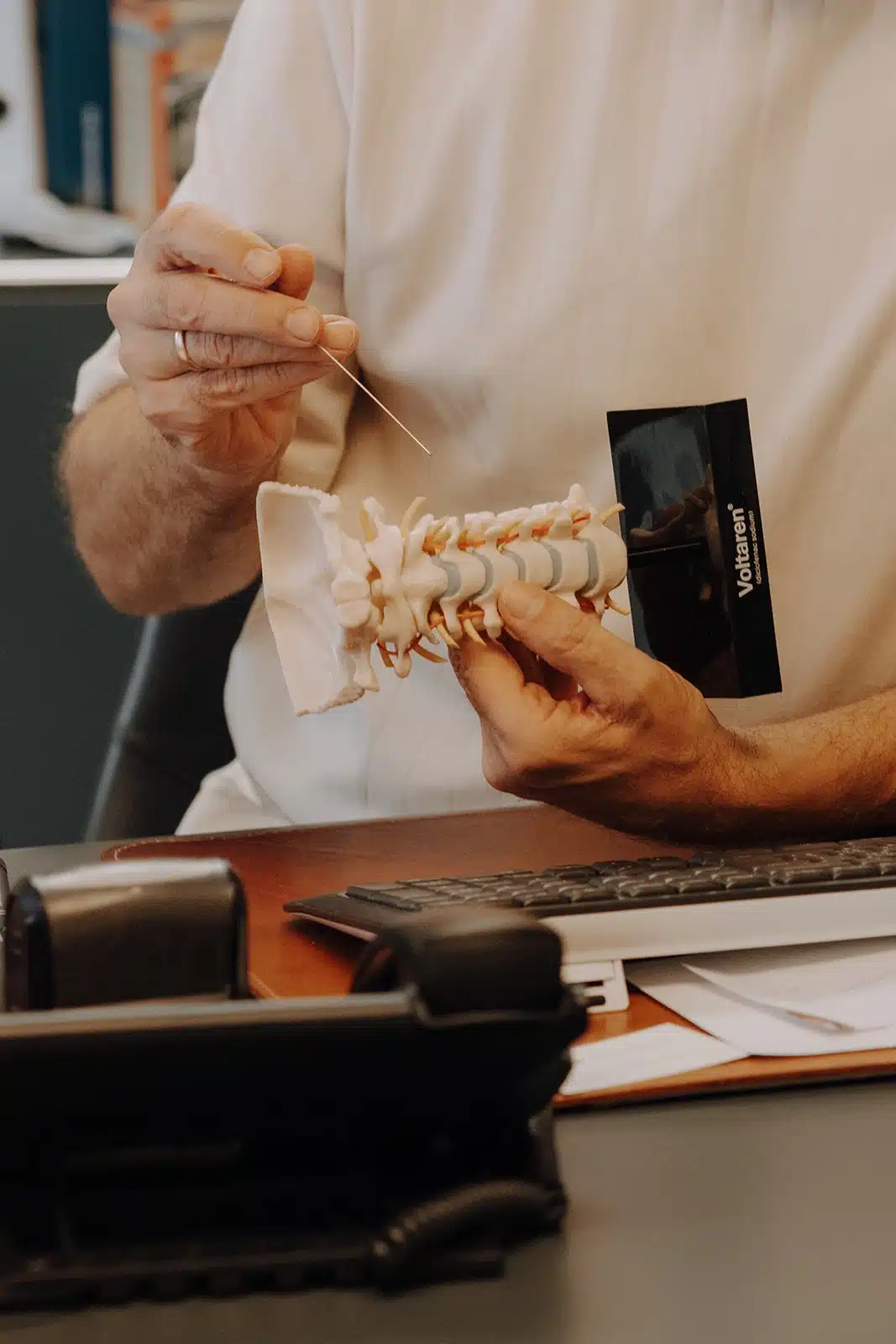
The cause of back pain is often difficult to identify precisely. In adults, age-related and load-related mechanical, or degenerative, wear of particular spinal structures is most common. These degenerative changes are natural but may cause persistent, limiting symptoms. Even with a careful medical history and examination, identifying the source of pain is often difficult. Even modern imaging methods, such as MRI, CT and PET-CT, do not always help. This is because various anatomical structures of the spine wear over a lifetime and may be responsible for pain. Degenerative changes in the intervertebral joints (facet joints) and/or discs are frequent causes. There are also many other causes, such as irritation of a nerve root (sciatica) or overloading of the back muscles.
The individual symptoms that bring patients to a doctor depend on the cause. Shooting, stabbing or burning pain is typical of nerve compression (lumbago), but can also occur less commonly with acute muscle tension and, chronically, as a sign of facet joint degeneration. Facet joint pain may also radiate into a limb as referred pain and thus imitate nerve compression, making diagnosis more difficult. If pain is accompanied by reduced sensation and/or strength in the legs, irritation of a nerve root is likely.
Many other specific causes exist besides these three briefly outlined examples.
A detailed medical history and a thorough physical examination are central to diagnosis. Imaging such as MRI, CT or X-rays helps in certain cases but is not always essential.
Targeted test injections have a very important role in assessing back pain. Local anaesthetic injections can be precisely administered under ultrasound or X-ray guidance. For example, a test injection around a suspected painful facet joint can establish whether pain temporarily decreases afterwards. If the reported pain subsides, it can be assumed to originate from that structure.
Treatment of chronic back pain is often complex and differs substantially from treatment of acute back pain. A single therapy is often no longer sufficient, making good treatment planning essential. Coordination of different measures is helpful.
Physiotherapy, manual medicine, chiropractic treatment, complementary treatments, medication and interventions (injections) all play a central role in chronic back pain treatment. Medication usually starts with basic analgesics such as NSAIDs, paracetamol and, if these are ineffective, metamizole. Morphine-type medicines, known as opioids, no longer have a role in chronic back pain. Interventional approaches such as nerve root blocks, thermal ablation of facet joint medial branches, steroid injections into facet joints, pulsed radiofrequency treatment of the dorsal root ganglion of a spinal nerve, neuromodulation procedures and surgery can be used specifically to relieve symptoms.